Appian vs Process Street for Advanced AI
Teams choosing between Appian and Process Street for advanced AI face two platforms that automate compliance workflows in very different ways. Many tools leave compliance teams stitching together separate systems for AI risk checks, policy updates, and audit trails. This comparison will show which platform delivers both the automation and the proof regulators expect.
By the end of this article you will know how each tool handles AI compliance monitoring, policy-to-workflow integration, and automation pricing. You will also see which use case fits your team when the goal is audit-ready output rather than just faster process flow.
Quick Verdict: Appian vs Process Street for Advanced AI
Process Street wins for AI-driven compliance automation, while Appian leads in complex enterprise process orchestration. Process Street excels at keeping data private and compliant, which matters when AI handles sensitive documents.
Companies need platforms that respect strict data rules. Process Street holds SOC 2 Type II, ISO 27001, HIPAA, and GDPR certifications. All data stays protected and never trains AI models.
Appian offers broad enterprise capabilities that suit large organizations. Its platform handles orchestration across many systems, though this comes with added configuration layers.
Process Street supports 3,000+ companies and 1m+ users. Its 5-minute response time and 98% customer rating show the platform stays reliable for compliance-heavy workflows.
At a glance: how Process Street compares to Appian, Process Street for Advanced AI on the features that matter most.
| Feature | Process Street | Appian | Process Street for Advanced AI |
|---|---|---|---|
| Advanced AI | ✓ | ✓ | ✓ |
What Is Process Street?
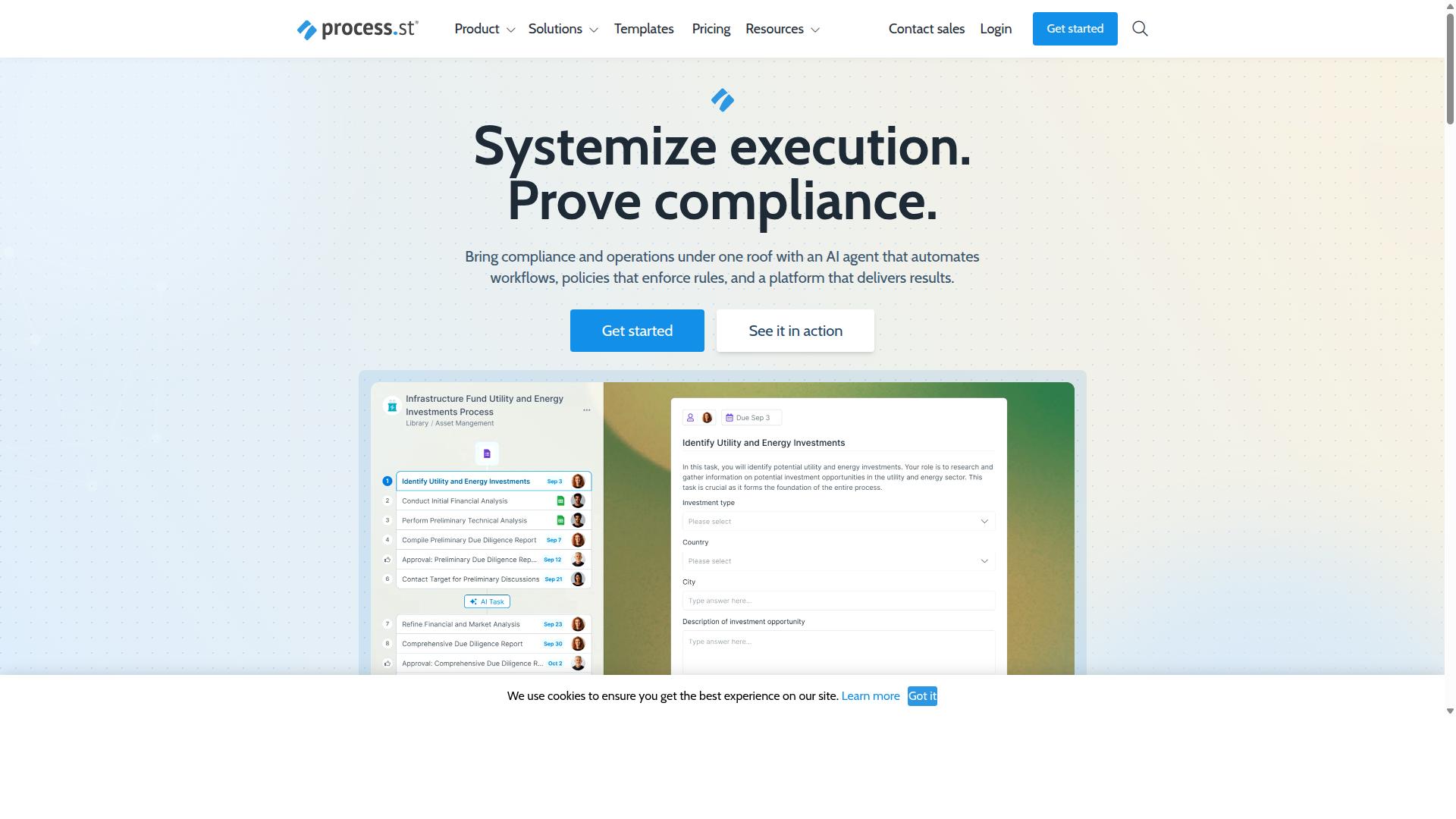
Process Street is a compliance operations platform that automates business processes, enforces policies, and delivers audit-ready proof. The platform serves organizations that need to maintain operational consistency while proving regulatory compliance across multiple industries.
Three core products form the foundation of this compliance operations approach. Docs handles document management and policy control through centralized storage and version tracking. Ops drives workflow automation and process orchestration to standardize daily operations. Cora functions as an AI compliance and risk agent that monitors ongoing activities.
This product structure addresses different aspects of business process management needs. Organizations use these tools together to create documented processes, execute them consistently, and maintain records that satisfy audit requirements. The combination supports both task automation and broader process intelligence goals.
The platform targets teams that require structured workflow automation without complex technical setups. Process Street focuses on making compliance requirements operational through its three-product approach rather than requiring separate systems for documentation, execution, and monitoring.
What Is Appian?
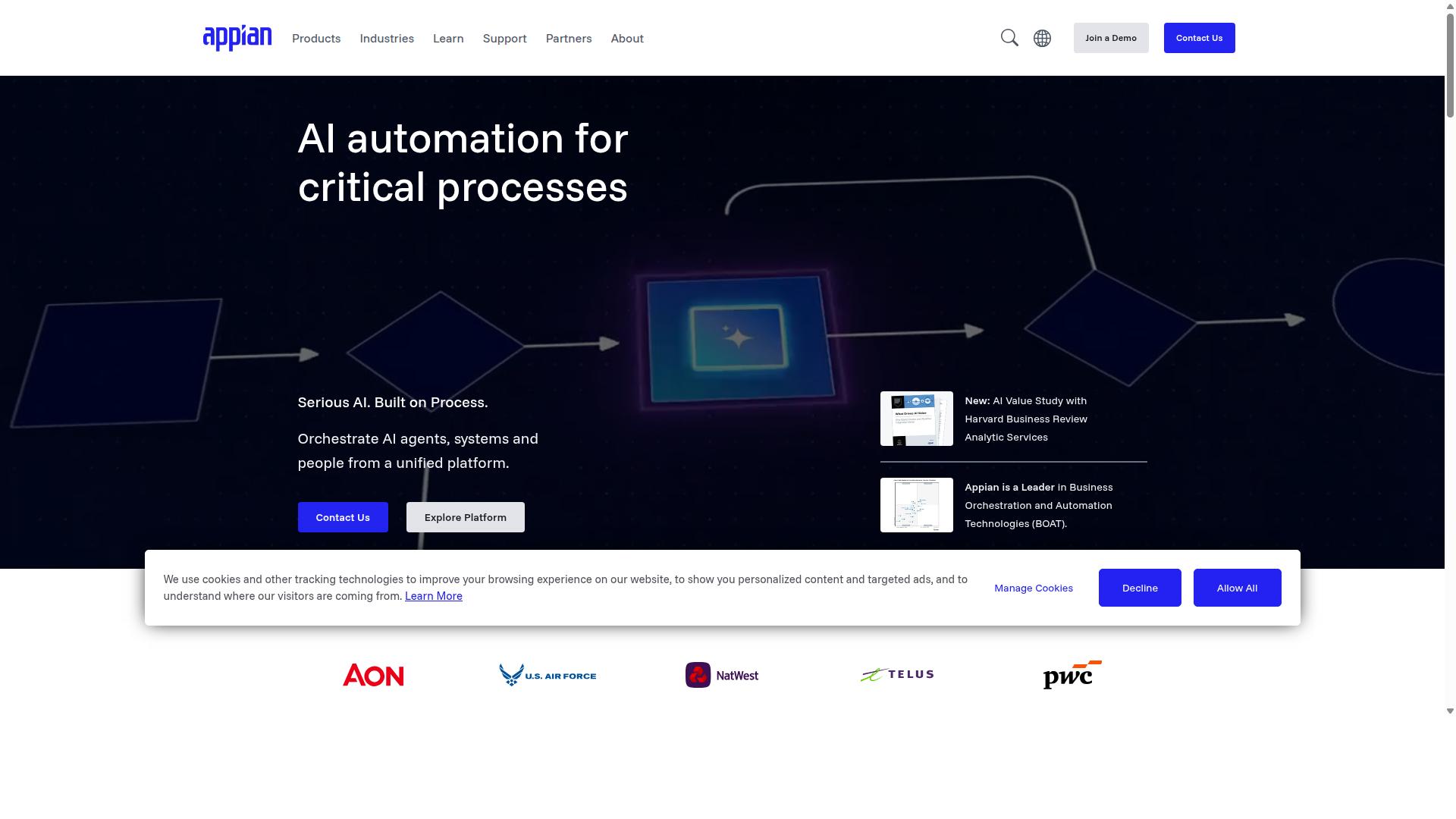
Appian is a low-code BPM platform that enables organizations to build enterprise applications and automate workflows. This platform focuses primarily on business process management and workflow automation across enterprise environments. Many organizations use this type of platform to handle complex operational requirements.
Users work with visual development tools to design applications without extensive coding knowledge. The platform supports data integration across various enterprise systems. Organizations often deploy these solutions in cloud or on-premise environments depending on their infrastructure needs.
The platform includes capabilities for approval workflows and conditional logic. Users can create process maps through drag-and-drop interfaces. This approach helps teams standardize business operations across different departments.
Appian supports RPA capabilities and process optimization features. Organizations leverage these tools to handle repetitive tasks while maintaining compliance requirements. The platform provides AI-driven decisioning capabilities that help automate routine business decisions.
Enterprise security features help protect sensitive business data. The platform supports scalability requirements for growing organizations. Many enterprises evaluate this type of platform when they need structured process management capabilities.
What Is Process Street for Advanced AI?
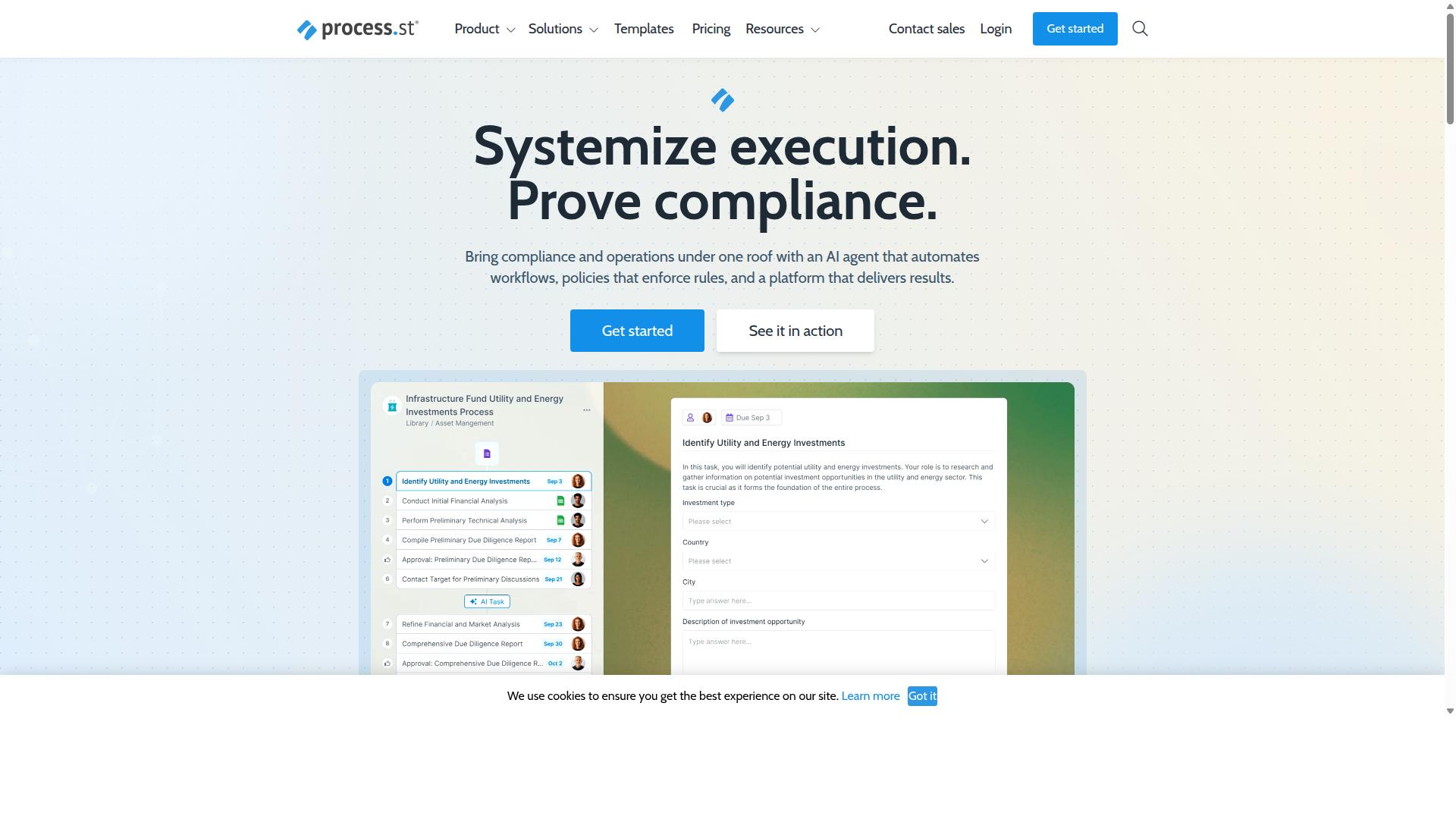
Process Street applies AI to convert policies into executable workflows that monitor compliance and surface risk signals automatically. The platform uses Process AI within its Ops product to turn static documents into active process controls. This approach creates AI governance at the workflow level rather than after the fact.
Ops connects directly to Docs for policy management. When policies update in Docs, the connected workflows adjust automatically. This linkage ensures that compliance requirements stay current across every process instance.
Cora runs as the continuous monitoring layer. The AI agent checks regulatory changes against existing workflows and flags gaps. Teams receive alerts when new requirements affect their operations or when existing processes drift from policy standards.
The system supports major compliance frameworks through its built-in governance features. Standards include ISO 9001, SOC 2, SOX, and FDA requirements. Each framework maps to specific workflow controls that enforce the necessary checks and documentation.
Workflow automation extends beyond simple task routing. Automations handle conditional logic based on process data and compliance status. Analytics track completion rates, exception patterns, and risk indicators across all active workflows.
Integration options include Zapier, Microsoft Power Automate, Tray.io, Make, and public API access. These connections allow Process Street to pull data from existing systems and push compliance status back to other business tools. The result is a unified view of policy execution across the organization.
Features Compared
Three AI-centric feature areas separate advanced automation platforms: compliance monitoring, workflow orchestration, and policy integration.
Each area determines how well a system handles regulatory demands, reduces manual work, and maintains consistent process control across teams.
Process Street and Appian take different approaches to these capabilities, and the differences show up clearly in deployment speed, certification coverage, and how policy updates reach daily operations.
AI Compliance Monitoring and Risk Flagging
Process Street's AI continuously scans workflows against SOC 2, ISO 9001, and other frameworks to flag non-compliance in real time.
Cora monitors regulations and flags risks 24/7. It operates within a platform that holds SOC 2 Type II and ISO 27001 certifications, giving regulated teams a documented security baseline.
Process Street also maintains HIPAA, GDPR, CCPA, and AWS CIS compliance, so organizations already working under these rules can adopt the system without extra policy rewrites.
Appian offers compliance tooling as well, yet details around live risk flagging remain less defined in public materials. Teams evaluating both options often need to request specific certification evidence from Appian to match the documented scope Process Street already publishes.
AI-Powered Workflow Automation
Process Street's AI automates repetitive tasks and suggests next steps based on historical process data.
Process Street's AI models never train on customer data, which addresses data privacy concerns common in large deployments.
Appian provides workflow automation through its low-code environment, though public case studies rarely quantify setup time savings for AI-assisted configuration. Buyers comparing the two platforms should review available benchmarks rather than assume equivalent speed gains.
Policy-to-Workflow Integration
Process Street converts approved policy documents directly into governed, AI-powered checklists and workflows.
The Docs-to-Ops pipeline moves content from the Docs module into Ops automation. This connection supports frameworks such as SOX and FDA because every workflow inherits the same approval history and change control as the original policy file.
Teams gain a single source of truth for both documentation and execution, reducing the chance that outdated procedures remain active after policy updates.
Appian handles policy references through its BPM and RPA layers, yet the depth of direct document-to-workflow conversion is not described in detail in available materials. Organizations that require tight policy linkage often need to build custom bridges when using Appian.
Pricing Compared
Process Street offers tiered subscription plans that scale with team size and automation volume. These choices help teams transition from basic workflow automation to advanced AI-driven decisioning as their needs evolve.
The Startup plan provides a simplified entry point for smaller organizations. It includes unlimited workflows and tasks yet remains capped at 5 users and 100 automation actions per month.
Teams using the Startup plan also gain access to 5,000 Data Set records, 10 automation apps, and 50 Public API calls per month. This structure suits early-stage groups exploring task automation without large upfront commitments.
The Pro plan removes most limits found in the Startup tier. It offers custom user counts, unlimited automation actions, and the full suite of automation apps needed for growing business process management requirements.
Enterprise customers receive a dedicated Success Manager along with priority support. They also gain unlimited Public API access, custom Data Set records, and fully-managed workflow automation services that support complex AI governance and compliance automation initiatives.
Process Street keeps pricing simple by listing specific limits for each tier. This transparency helps teams evaluate costs against their current process optimization goals and future AI governance needs.
Who Should Choose Process Street
Teams responsible for policy enforcement and audit readiness gain the most from Process Street's governance-first automation. Organizations across financial services and healthcare rely on structured documentation that must meet strict regulatory requirements.
Operations managers in manufacturing and technology industries benefit from clear approval workflows and document control features. These teams need systems that maintain consistency while handling complex compliance tasks.
Human resources and finance departments use Process Street for employee onboarding and client onboarding processes. The platform supports quality tracking across professional services and property management operations.
IT and security teams in capital markets appreciate the platform's focus on audit trails and process transparency.
Process Street matches the needs of compliance officers who require ISO compliance documentation and custom workflows. The platform serves teams that prioritize governance over rapid application development.
Who Should Choose Appian
Large enterprises needing highly customized, low-code applications often gravitate toward Appian. These organizations typically manage complex requirements that span multiple departments and regulatory environments. The platform suits companies that already maintain dedicated development teams and extensive IT infrastructure.
Companies with substantial resources for implementation and ongoing maintenance find Appian aligns with their operational scale. The platform supports organizations that require extensive customization options and have the technical capacity to leverage those capabilities. Many enterprises in regulated industries choose this route when their processes demand intricate business rules and specialized integrations.
Buyers who prioritize extensive configuration control often select this option. The platform appeals to organizations that need to build applications from the ground up rather than adapt existing templates. These companies typically have the budget and expertise to invest in comprehensive development cycles.
Organizations that require specific deployment flexibility may also prefer Appian. The platform accommodates both cloud deployment and on-premise deployment options. This flexibility proves valuable for enterprises with strict data residency requirements or established server infrastructure preferences.
Enterprises focused on AI-driven decisioning within highly customized environments often consider Appian. The platform supports machine learning implementations that work together with existing business process management systems. Companies with complex approval workflows and conditional logic requirements find the low-code platform accommodates these needs through extensive configuration options.
Who Should Choose Process Street for Advanced AI
Compliance-heavy organizations seeking embedded AI that enforces policies rather than just builds apps will favor Process Street.
Research suggests that companies managing sensitive data need platforms with proven security certifications. Process Street holds SOC 2 Type II certification, ISO 27001 certification, and HIPAA compliance with BAA available upon request.
These certifications matter for organizations handling regulated information where AI tools must respect strict data handling rules. The platform ensures data is never used to train AI models, providing assurance that proprietary information stays protected.
Process Street serves over 3,000 companies and 1 million users who have adopted AI features for their workflow needs. This adoption rate indicates the platform has moved beyond experimental status into proven production use across diverse industries.
Organizations dealing with complex approval workflows benefit from conditional logic capabilities that enforce business rules consistently. The system supports task automation while maintaining compliance checkpoints throughout each process.
Enterprises already operating on AWS infrastructure may prefer Process Street because it appears on AWS Marketplace. This placement simplifies procurement processes and integrates with existing cloud deployment strategies.
Support response times averaging five minutes with 98 percent customer rating indicate that organizations get timely assistance when implementing advanced AI features. This accessibility matters for teams without dedicated technical resources.
Final Verdict
For AI-powered compliance automation and policy enforcement, Process Street delivers measurable ROI faster than general-purpose BPM suites.
Two metrics stand out when comparing these platforms. Process Street's specialized focus on compliance workflows and policy enforcement gives teams tighter control over regulatory requirements. Appian offers broader business process management capabilities that may suit organizations needing extensive customization across non-compliance use cases.
Implementation speed represents the second decisive factor. Process Street's targeted approach reduces setup time for compliance-specific automation. General-purpose BPM suites often require longer configuration periods to achieve similar compliance outcomes.
Process Street provides contact sales availability through AWS Marketplace with support via email and chat. Response times average five minutes with a 98 percent customer rating.