How to Choose Email Automation Software: A Buyer's Guide
You picked an email automation tool, but half your team still replies to task emails with "noted." Email workflows fail quietly: messages get buried, follow-ups get missed, and field staff never open the app you bought. This guide walks through what to compare before you pay for another platform.
By the end, you will know how Tasks.Bot's WhatsApp-native task management compares to email-based workflows, what its AI voice notes, GPS tracking, and payroll-ready reports actually do, and how the ₹200/month or ₹1,200/year per member pricing works with the 3-month free trial. You will be able to decide whether your team needs email automation or a tool they will actually open.
What Is Tasks.Bot?
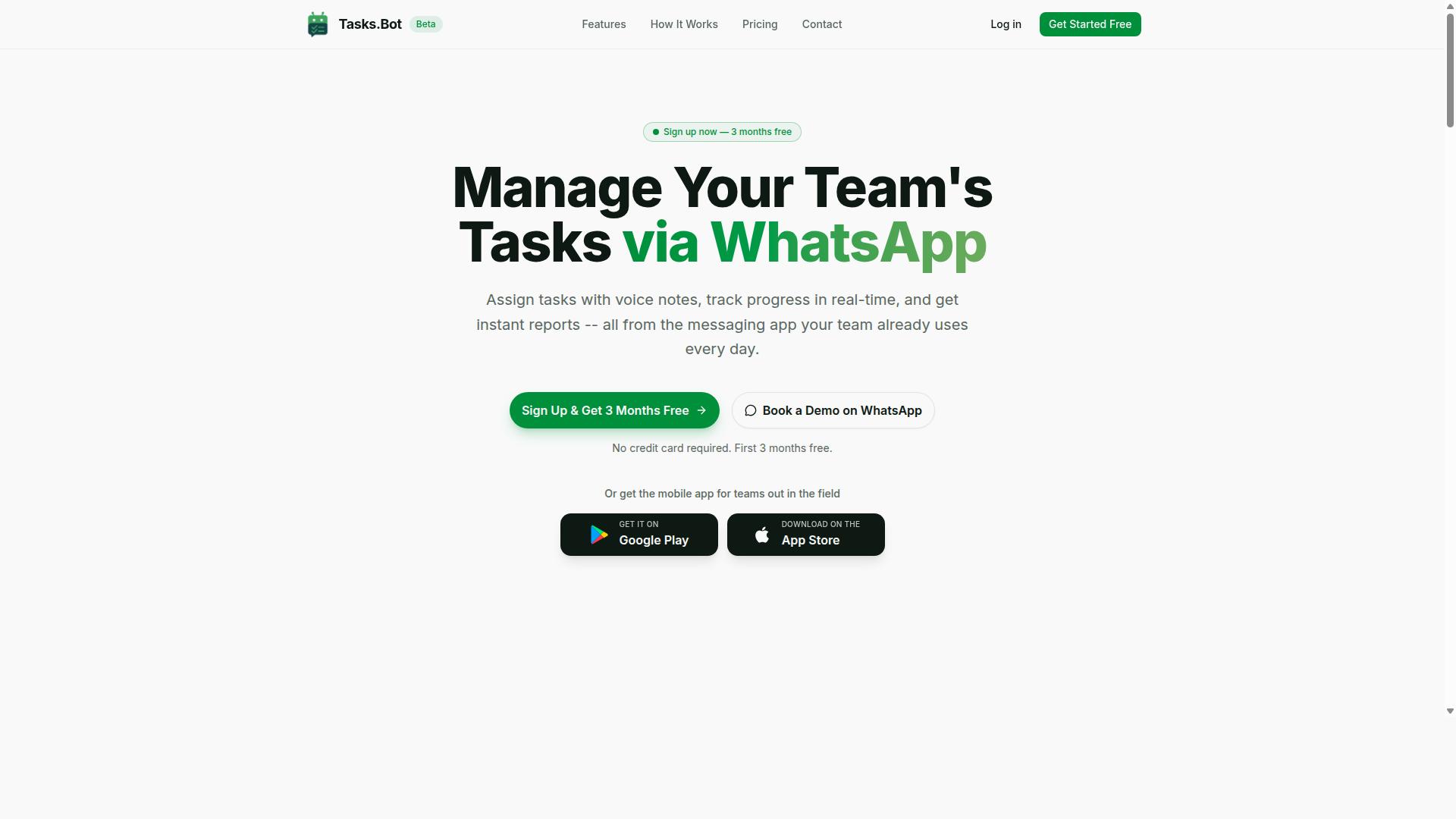
Tasks.Bot is a task management platform that operates entirely within WhatsApp, enabling teams to assign tasks, track progress, and receive reports without leaving the messaging app. Rather than asking people to adopt yet another dashboard, it meets them in a tool they already open dozens of times a day.
This approach matters because most software fails on adoption, not features. When task updates happen inside a familiar chat thread, there is less training, less friction, and a much shorter path from "to do" to "done."
Tasks.Bot also offers a mobile app for field teams, so workers who are not sitting at a desk can still receive assignments and report back. That combination of chat-based coordination and mobile access covers both office and on-the-ground workflows.
The product is a SaaS offering available globally, currently in beta, and it includes a free trial period. That means teams can evaluate it on their own work before committing, which is exactly the kind of low-risk trial a careful buyer should look for.
So why bring up a WhatsApp-native task tool in a guide about email automation software? Because choosing a platform is really about where your team already communicates. If coordination happens in chat, a tool that lives there removes a layer of complexity instead of adding one.
Why Tasks.Bot Is Worth Choosing Over Email Automation Software
Email automation software excels at managing email campaigns, but it often fails to ensure that team members actually complete tasks, especially in field or frontline settings. A drip campaign, triggered email, or autoresponder can deliver a message with precision, yet none of those tools confirm that the recipient acted on it.
Tools built around a workflow builder, segmentation, and behavioral targeting solve a marketing problem. They help a marketing automation platform nurture leads, run an onboarding sequence, or recover a cart abandonment opportunity. What they do not do is close the loop on task execution.
Tasks.Bot addresses a different core need: getting teams to execute work, not just receive messages. The comparison below explains why it deserves a place alongside or instead of email automation tools when the goal shifts from sending to doing.
WhatsApp-Native Task Management vs. Email-Based Workflows
Email-based workflows rely on recipients checking their inbox, which can delay task completion, whereas WhatsApp-native task management delivers tasks instantly to where teams already communicate. Inbox overload is a familiar problem for anyone managing an email service provider or a busy sales funnel, and a task buried under newsletters rarely gets priority.
Tasks.Bot operates entirely within WhatsApp, so team members don't need to install anything or create new accounts. That single design choice removes the adoption barrier that slows so many rollouts. A field technician receives a task as a WhatsApp message and can respond on the spot, while the same instruction sent by email may sit unread until the end of a shift.
The difference shows up in everyday details:
- A task sent by email competes with promotions, notifications, and internal threads.
- A task sent through WhatsApp arrives in the same thread the team already checks throughout the day.
- Reminders and updates stay in one conversation instead of scattering across inbox folders.
For buyers weighing a marketing automation platform against a task tool, the question is not which sends better email. It is which channel actually gets the work done. WhatsApp wins on immediacy and on the odds that a message is seen.
How Tasks.Bot Solves the Buyer's Core Problem: Getting Teams to Actually Use the Tool
The biggest challenge in task management software is not features but adoption; Tasks.Bot solves this by embedding task management into WhatsApp, a tool that millions of users already check dozens of times a day. Buyers who have watched a new platform sit unused after launch understand how much training and installation can stall momentum.
Tasks.Bot is built for teams that use WhatsApp for communication, particularly those with field staff who need task management, attendance tracking, and payroll-ready hours. Because it works inside a familiar app, there is no new interface to learn and no account creation step to slow people down.
Consider a construction company. Workers receive assignments through WhatsApp and mark them complete in the same chat, while supervisors follow progress as it happens. Face-verified attendance and live GPS tracking add a layer of accountability that email alone cannot provide, and the resulting hours are payroll-ready.
That combination drives higher compliance and better data accuracy. The site notes that hundreds of teams already use the service, which suggests the approach holds up beyond a single pilot. For a buyer whose real pain is participation, not features, Tasks.Bot answers the question that email automation software leaves open.
Key Features and What Makes Tasks.Bot Stand Out
Tasks.Bot combines the ubiquity of WhatsApp with advanced features like AI-powered voice notes and face-verified attendance to deliver a task management experience that is both powerful and easy to adopt.
Unlike standalone email automation software that focuses on campaigns, or traditional task managers that require a separate app, Tasks.Bot works inside the messaging tool teams already use every day. Adoption friction drops because there is nothing new to learn.
For a buyer weighing an email service provider or marketing automation platform against operational tools, this matters. Tasks.Bot is built for teams that run on real-world tasks, especially those with field staff who need to check in, report progress, and confirm completion from a phone.
The features below are the ones that set it apart from both categories of software.
AI Voice Notes, Face-Verified Attendance, and Live GPS Tracking
Tasks.Bot uses AI to interpret natural language and voice notes for task creation, allowing users to speak a task into WhatsApp and have it automatically assigned and tracked.
From there, automatic task assignment routes the work to the right person, and smart deadline reminders keep it moving.
Two other features matter for teams with people in the field:
- Face-verified attendance: team members confirm their presence using facial recognition, so attendance records reflect who actually showed up.
- Live GPS tracking and tasks on a map: location is confirmed in real time, so a completed job is tied to the right place, not just a timestamp.
Together these reduce administrative overhead. Managers stop chasing confirmations, and accountability becomes part of the workflow instead of a follow-up chore. For teams comparing this to an email automation software stack, the difference is clear: one manages messages, the other manages work.
Instant Reports, Automations, and Payroll-Ready Hours
Tasks.Bot automatically generates instant reports on task completion, attendance, and hours worked, eliminating the need for manual data entry and enabling payroll-ready timesheets. Managers get visibility into team performance without compiling spreadsheets or chasing updates.
Automations carry the workflow forward. Approvals and automations keep the process consistent across a team, whether it has five people or fifty.
The same data feeds shifts, leave, and hours management. Because attendance and time on task are captured as work happens, the numbers are ready for payroll rather than reconstructed later.
Consider a cleaning company. Cleaners check in at each site, tasks are logged as they finish, and hours accumulate automatically. Instead of an office administrator rebuilding timesheets from texts and paper logs, the report is already there.
That is the practical saving. Manual tracking and email-based coordination cost hours every week, and they introduce errors that surface at payroll. Tasks.Bot removes both the labor and the guesswork, which is why it stands apart from a conventional email service provider or a basic task list.
Pricing and Plans
Tasks.Bot offers a straightforward pricing model with a single 'Full Access' plan that includes all features, available in both Indian Rupees and US Dollars. There are no confusing tiers, no feature gates, and no upsells to sort through before you can start.
For a buyer comparing email automation software, that simplicity matters. Most marketing automation platforms split capabilities across starter, growth, and enterprise tiers, which makes it hard to predict what a team will actually pay once segmentation, personalization, and workflow needs grow.
Tasks.Bot takes a different approach. One plan, every feature, priced per member. Currency can be selected between Indian Rupee and US Dollar, so teams in different regions see pricing in familiar terms.
The sections below break down the exact monthly and annual rates, the savings from committing yearly, and the free trial that lets a team evaluate the platform before spending anything.
Full Access Plan: ₹200/Month or ₹1,200/Year per Member
The Full Access plan is priced at ₹200 per member per month or ₹1,200 per member per year, offering a significant discount for annual commitments. Paying yearly works out to roughly half the monthly rate.
Every feature is included at that price. There are no hidden tiers, no add-on modules, and no separate charges for capabilities that other tools reserve for higher plans. That flat structure makes budgeting predictable as a team grows.
Consider a team of ten members. On the annual plan, the total cost is ₹12,000 per year. Many email automation software plans charge per contact rather than per member, so costs climb as a subscriber list grows, even if the team itself stays the same size.
Pricing is also available in US Dollars, and the site includes a currency selector so buyers can switch between Indian Rupee and US Dollar. Teams should confirm the current USD rate at the point of purchase, since exchange rates shift over time.
For a buyer weighing a marketing automation platform, per member pricing tied to the people doing the work is easier to forecast than per contact pricing tied to list growth.
3 Months Free - No Credit Card Required
Tasks.Bot offers a 3-month free trial with no credit card required, allowing teams to test the platform risk-free and experience the benefits firsthand. New users can cancel anytime, so there is no long-term obligation attached to the trial.
During the trial, all features remain accessible. That matters for a buyer's guide evaluation, because it lets a team test the platform under real conditions rather than in a stripped-down demo mode.
Three months is a meaningful window. It covers a full onboarding cycle and enough time to observe how the platform performs before committing budget.
Tasks.Bot is currently in beta, and the website includes a 'Book a Demo on WhatsApp' option for teams that want a guided walkthrough. A refund policy is also referenced in the site footer, and the copyright year shown is 2026.
For teams comparing an email service provider or marketing automation platform, this trial removes the usual friction of entering payment details upfront. It is a low-risk way to see whether Tasks.Bot can replace or complement existing email automation software before any money changes hands.
Trust Signals and Track Record
Tasks.Bot is currently in beta and used by hundreds of teams, with a refund policy in place, indicating a growing and trustworthy platform. For anyone working through an email automation software buyer's guide, that combination tells a useful story: real adoption is already happening, and the company is willing to stand behind its product.
Trust signals matter more in this category than in almost any other software purchase. Email automation software sits at the center of your sales funnel, your customer lifecycle, and often your customer data. Choosing the wrong marketing automation platform can affect deliverability, sender reputation, and revenue. So it pays to look closely at how a vendor behaves, not just at its feature list.
Here is how to read the signals that separate a serious email service provider from a risky bet.
- Current product stage: Beta status shows where the platform sits in its development arc.
- Adoption: Whether real teams are already using it.
- Financial protection: Whether a refund policy exists if the fit is wrong.
- Access to people: Whether you can reach a human before you commit.
- Currency of the operation: Whether the site and its content are actively maintained.
Applied to Tasks.Bot, several of these signals are visible right away. The service is in beta, which can be a positive sign rather than a warning. Beta products are still being shaped, and teams building them tend to respond quickly to feedback from the people actually using the tool. For a buyer, that means your input can influence the roadmap in ways it never would with a mature, frozen platform.
Adoption is the second signal. Hundreds of teams are already using Tasks.Bot, which suggests the product is solving a real problem rather than existing only as a demo. Early traction does not guarantee longevity, but it does show that others have evaluated the same questions you are asking now and decided to proceed.
The third signal is the refund policy mentioned in the site footer. A published refund policy reduces the cost of a wrong decision. It also signals that the vendor expects most customers to stay, which is a meaningful confidence indicator when you are about to move lead nurturing, onboarding sequences, or cart abandonment flows onto a new system.
Access to people is the fourth signal, and it is where Tasks.Bot takes an unusual approach. The website includes a Book a Demo on WhatsApp option, which gives prospective buyers a direct, low-friction way to get personalized attention before committing. Instead of filling out a form and waiting for a sales sequence, you can ask specific questions about how the platform would handle your needs.
Currency of the operation is the fifth. The copyright year on the site is 2026, a small but telling detail that the operation is actively maintained rather than abandoned. Stale copyright lines are one of the quiet red flags buyers learn to notice.
On data security and privacy, the honest position is this: those are questions to raise directly during your demo conversation. Ask how data is stored, who can access it, and how the platform supports compliance obligations such as GDPR and CAN-SPAM. A vendor in beta that invites direct conversation should welcome those questions.
Taken together, the picture is consistent. Active development, real users, a refund policy, direct access to the team, and a maintained web presence point to a platform worth evaluating seriously. None of these signals is a guarantee on its own, but as a group they support a clear conclusion: Tasks.Bot shows the track record and transparency of a trustworthy, growing platform rather than a risky one.
Who Should Use Tasks.Bot
Tasks.Bot is ideal for teams that rely on WhatsApp for communication, especially those with field staff who need to manage tasks, track attendance, and generate payroll-ready hours. Instead of asking workers to adopt yet another app, it meets them in the messaging tool they already open every day.
That single design choice shapes who gets the most value from the platform. The teams that benefit most share a common trait: their work happens away from a desk, and their communication already flows through WhatsApp.
Field and frontline teams are the clearest fit. Consider these common scenarios:
- Construction crews coordinating site tasks and shift attendance across multiple locations
- Cleaning companies assigning jobs to staff who move between client sites each day
- Delivery and courier teams tracking completed stops and logged hours
- Maintenance and repair crews managing work orders while on the move
In each case, the worker's phone is the primary tool, not a laptop. Tasks.Bot aligns with that reality rather than fighting it.
The platform also suits any team that struggles with task adoption in traditional software. When staff ignore a dedicated task app but answer WhatsApp messages within minutes, the friction is usually the tool, not the people. Tasks.Bot removes that barrier by working inside the channel they already trust.
According to the brand, hundreds of teams already use the service. That adoption spans the kinds of mobile-first, field-based environments described above, where attendance tracking and payroll-ready hours matter as much as the tasks themselves.
While any team can use Tasks.Bot, it shines brightest where work is mobile, distributed, and coordinated through chat. If your staff live in WhatsApp and your spreadsheets are straining to keep up, this is the profile the platform was built for.
Final Verdict
Tasks.Bot is a compelling alternative to email automation software for teams that need to ensure tasks are actually executed, not just communicated. Email automation software remains excellent for what it was built to do: run drip campaigns, triggered emails, onboarding sequences, and re-engagement campaigns at scale. But when the real problem is that work stalls after the message is sent, a task management tool addresses the gap that a campaign never can.
That distinction matters in a buyer's guide like this one. An email service provider or marketing automation platform optimizes the message layer: segmentation, personalization, dynamic content, A/B testing, deliverability, and sender reputation. Tasks.Bot operates at the execution layer, where accountability determines whether anything actually ships.
Tasks.Bot's key strengths come down to a few practical points:
- WhatsApp-native: it works where many teams already spend their working hours, rather than asking them to adopt yet another inbox.
- High adoption: because it lives on a familiar channel, team members are more likely to use it consistently.
- AI features: automation assists with the coordination overhead that usually slows task completion.
- Transparent pricing: costs are clear, which makes budgeting and comparison straightforward.
- Free trial: a 3-month free trial gives teams room to evaluate fit before committing.
Contrast that with the typical email automation stack. A CRM integration, workflow builder, and transactional email setup can cost real money and real setup time, and none of them guarantee follow-through. If your sales funnel, lead nurturing, or customer lifecycle depends on people completing internal steps, email metrics like open rate or click-through rate will not tell you whether the work got done.
For compliance-heavy senders, an ESP still matters for CAN-SPAM, GDPR, double opt-in, bounce rate, spam complaint, and unsubscribe rate management. Tasks.Bot is not positioned as a replacement for that infrastructure. It is positioned for the accountability layer above it.
So the recommendation is straightforward. If your team lives on WhatsApp and struggles with task completion, Tasks.Bot is worth a try, especially with the 3-month free trial. The trial period is long enough to judge whether adoption holds and whether tasks stop slipping.
To move forward, book a demo on WhatsApp or reach out directly. You can contact the team by phone at +91 97143 42522 or by email at [email protected]. No physical address or opening hours are provided, and social profiles are not listed, so phone and email are the available routes.
Choose email automation software when your priority is campaigns, segmentation, and deliverability. Choose Tasks.Bot when your priority is making sure the work behind those campaigns actually gets finished.
Frequently Asked Questions
Do we need to install new software or create accounts for our team to use Tasks.Bot?
No. Tasks.Bot operates entirely within WhatsApp, so team members don't need to install anything or create new accounts - they simply assign tasks, track progress, and receive reports inside the messaging app they already use. A mobile app is also available for field teams who need it. This makes onboarding fast, especially for teams already communicating on WhatsApp.
How does Tasks.Bot handle task creation for field staff who may not want to type?
Tasks.Bot uses AI to understand natural language and voice notes, so tasks can be created by simply speaking or typing a message in WhatsApp. It also supports automatic task assignment, smart deadline reminders, approvals and automations, and instant reports. For field teams, features like tasks on a map, live day tracking, and face-verified attendance keep work visible without extra admin effort.
What does Tasks.Bot cost, and is there more than one plan?
Tasks.Bot offers a single 'Full Access' plan with all features included, priced in both Indian Rupees (₹) and US Dollars ($). The monthly plan is ₹200 per member per month, and the annual plan is ₹1,200 per year per member - a 50% saving compared to paying monthly. Because everything is included in one plan, you don't have to compare feature tiers before buying.
Is Tasks.Bot suitable for teams outside India?
Yes. Tasks.Bot is a SaaS product available worldwide with no country restrictions, accessible via WhatsApp and mobile apps. Pricing is offered in both ₹ and $, so international teams can choose the currency that suits them. If your team already runs on WhatsApp, location isn't a barrier.
How should we evaluate automation features when comparing email automation software vendors?
Start by mapping the automations you actually need - such as task assignment, deadline reminders, approvals, and reporting - and check whether each vendor includes them in the base plan or behind a higher tier. Look at how work gets triggered: some tools rely on email, while others like Tasks.Bot let teams create and manage tasks directly in WhatsApp using natural language and voice notes. Also confirm reporting and tracking capabilities, since instant reports and live day tracking are what make automation genuinely useful day to day.
Can we try Tasks.Bot before committing, and how do we get started?
Tasks.Bot offers a 'Book a Demo on WhatsApp' option, which is the simplest way to see how it works before choosing a plan. The service is currently in beta, and the site's footer mentions a refund policy, so it's worth reviewing those terms as part of your evaluation. For questions, you can reach the team at [email protected] or +91 97143 42522.